
Microsoft unveils Maia 300 AI chip to reduce reliance on Nvidia, promises 40 pct greater efficiency
 Follow Us
Microsoft unveils Maia 300 AI chip for better efficiency.
The chip promises 40 per cent more AI tokens per watt.
Maia 300 deployments are expected to begin in 2027.
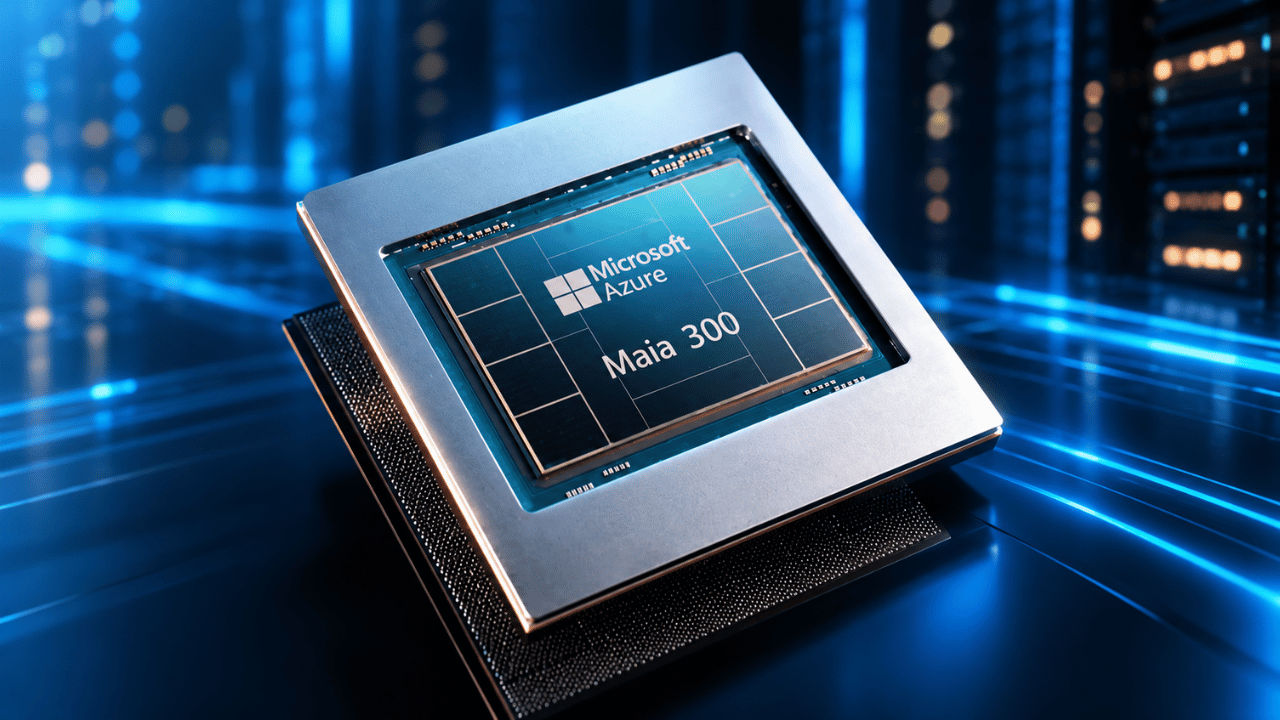

Microsoft has officially unveiled Maia 300, its third-generation in-house artificial intelligence chip, designed to run AI services more efficiently. According to the company, the new multi-chipset accelerator is expected to deliver 40 per cent more AI tokens per watt than leading graphics processing unit-based systems, potentially improving performance while reducing energy consumption. Microsoft plans to begin production deployments of Maia 300 in 2027, alongside an expansion of its Maia infrastructure to multi-gigawatt capacity. The chip is expected to support demanding AI workloads, including inference and complex reasoning tasks. Its deployment could help Microsoft scale services such as Copilot while improving efficiency across its growing AI infrastructure.
 Survey
Microsoft Azure Maia 300: Revealed
Microsoft CEO Satya Nadella recently took to X to announce the company’s homegrown AI chip, the Maia 300, describing it as Microsoft’s ‘biggest bet yet on our own silicon.’ According to Microsoft, the Maia 300 is built to handle demanding AI tasks, which include long-context reasoning, latency-sensitive conversations and sustained, multi-step agentic tasks.
Today we are announcing our biggest bet yet on our own silicon. Starting next calendar year, we will scale our Maia family to multi-gigawatt deployments, making it the primary inference system for our own product and services. And we’re introducing Maia 300, which delivers 40% more tokens per watt compared to leading GPU-based systems. We are already deploying Maia 200 across the US, Europe, and Australia, delivering up to 1.7x more tokens per watt across experiences in Teams and Copilot. Our goal is to build on the full-stack efficiency gains we’ve already seen, while continuing to bring the latest innovations from across the ecosystem into our fleet.
— Satya Nadella (@satyanadella) October 12, 2026
In a blog post, Microsoft’s Scott Guthrie added that the chip uses a multi-chiplet design that separates compute, memory-controller and input-output functions, allowing different parts to use technologies suited to their specific tasks. According to the company, a data centre rack containing 96 Maia 300 accelerators can deliver up to seven times the rack-scale token throughput of Maia 200.
Also read: Apple October 13 event: India timings, how to watch it live and what to expect
Will Microsoft replace Nvidia and AMD chips?
At the time of writing, there are no official announcements that Microsoft plans to stop using Nvidia and AMD processors entirely. Rather, Microsoft says it wants Maia to become the primary inference system for its own products and services, with inference referring to the process of generating responses from trained AI models.
Microsoft Azure Maia 300 chip: How it could affect Copilot users
The new Maia 300 chipset can potentially improve the response times across services such as Microsoft Copilot, as the efficient chips could allow Microsoft to handle more AI requests without a similar increase in power consumption.
However, it’s important to note that at the time of writing, the company has not announced any price cut on the service. Hence, we believe that the actual benefits will depend on how the chip is deployed and how individual services are optimised.
Microsoft Azure Maia 300: Launch Timeline
Microsoft says Maia 300 will begin production deployments in 2027, the same year the company plans to scale its Maia infrastructure to multi-gigawatt capacity. To give you better context, Microsoft first introduced its Maia AI chip in 2023, followed by the second-generation Maia 200 in January 2026.
According to the company, Maia 200 is already serving production workloads, including Microsoft Copilot, with GitHub Copilot and Microsoft Foundry to follow by the end of the year, laying the groundwork for the next generation of its AI infrastructure.


